7 Better TinEye Alternatives for Free Image Lookup in 2026
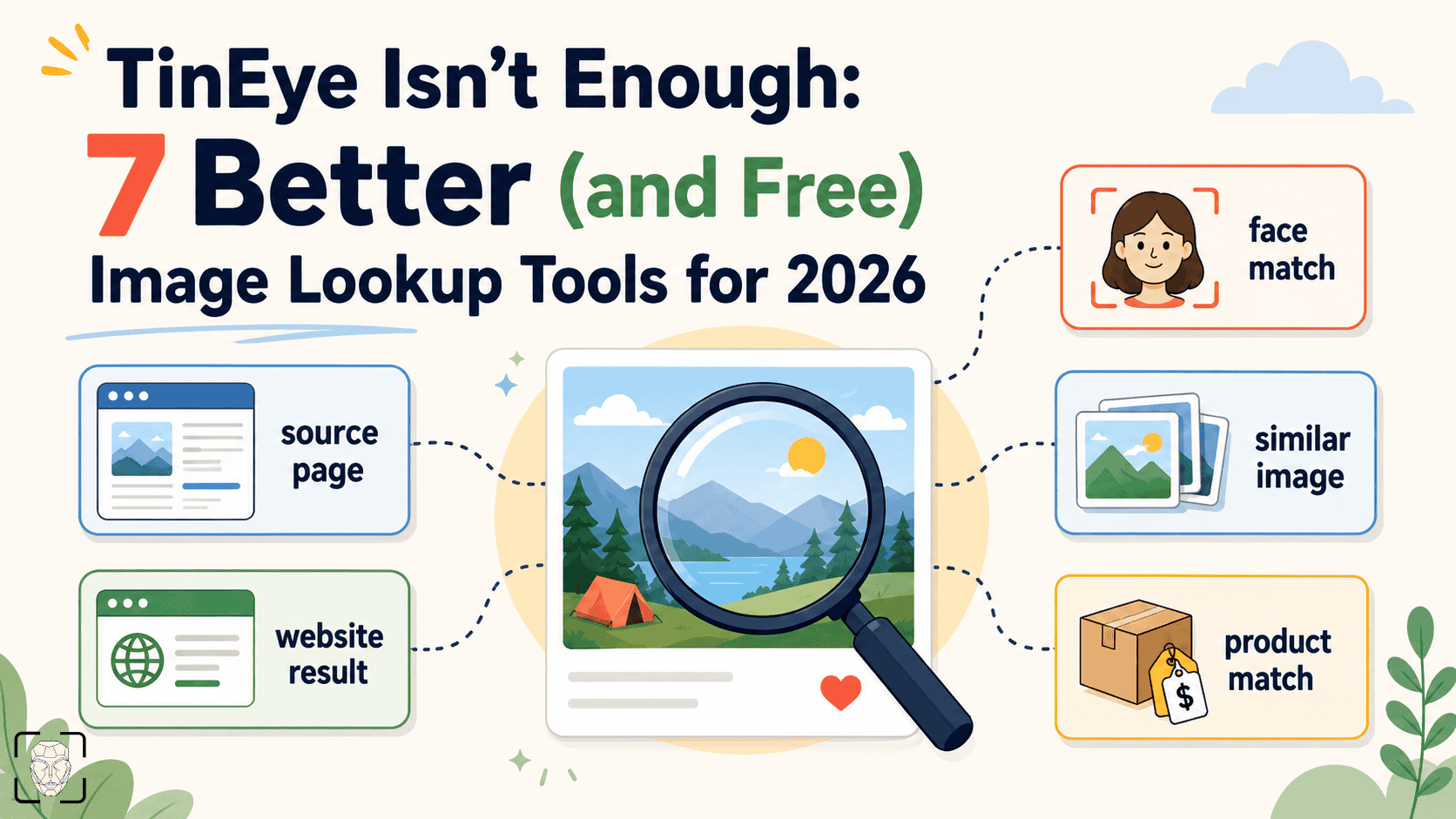
7 Better TinEye Alternatives for Free Image Lookup in 2026

I’ve used TinEye for years, and while it’s still useful for basic searches, it struggles to find results for faces, edited photos, and social media images.

So, I tested dozens of reverse image search tools and narrowed it down to 7 reliable TinEye alternatives that are better at finding sources, faces, and products for free and paid.

Use CaseRecommended Tool
Fake profiles/Edited/AI images/CatfishProFaceFinder, Eyematch.ai
General Image Lookup, Products/BrandsGoogle Images, Pic Detective
Viral content/memesCopySeeker, Bing, Google
Public figures/influencersBing, CopySeeker, Baidu
Chinese figures/content + AI assistantBaidu Image Search
Deep source trackingPic Detective, CopySeeker 

1. ProFaceFinder: Best Tool for Face Search and Catfish Checks

Looking for Best Reverse Face Search for People?
Upload a photo and let ProFaceFinder do the digging. It finds matches even when PimEyes doesn’t, across Social Media, dating apps, and more.

ProFaceFinder is a high-quality image and face search tool that finds both exact and similar faces across public platforms – with far better accuracy than TinEye.

It works by scanning social networks, dating profiles, professional sites, and handles these well:

  • Reused & heavily filtered images
  • AI-altered or generated faces 

While TinEye is less effective with newer, web-based images, ProFaceFinder uses the latest facial-recognition technology to confirm photo ownership.

Pricing is pretty practical, with no complicated tiers or hidden extras:

  • $7.952 searches
  • $11.955 searches

There are no monthly plans. You pay once, search, get the results, done. 

ProFaceFinder works well with cropped images, brands, and locations, making it ideal for verifying identities, checking potential catfishes, and spotting impersonators

2. Pic Detective: Best at Tracking Image Sources for Free

Pic Detective Best at Tracking Image Sources for Free

Pic Detective is a 100% free reverse image search tool used to find image sources through public pages.

Unlike TinEye, which is very limited, Pic Detective searches the web broadly and finds matches from socials, blogs, Pinterest, Reddit, TikTok, Spotify, and more.

I liked how practical Pic Detective is, with built-in search tips, access to sources, and no account or setup required. It’s not perfect with heavily edited or cropped images, but it works well for basic tracking.

Results can include a wide range of matches (often hundreds), from exact to similar images, with filters like size or website helping narrow them down fast.

Pic Detective also finds branded items with direct shopping links. I looked up a photo of a Gucci bag, and Pic Detective returned 59 matches; TinEye found 2.

3. Copyseeker: Best for Finding Image Copies

Copyseeker Best for Finding Image Copies

Copyseeker is an image lookup engine whose main focus is finding identical copies of an image on public platforms like social media, news sites, and blogs.

It’s surprisingly effective for viral content (celebrities, public figures, and memes), often returning 50+ matches while TinEye finds nothing. 

Users can choose Copyseeker’s free version (accurate but ad-supported) or upgrade for faster results, unlimited searches, and no ads:

  • $9 per month
  • $90 per year
  • $450 for a lifetime plan

That said, Copyseeker struggles with low-quality photos and, like TinEye, it’s less effective for photos of regular people with no online presence.

Even so, it’s usually more useful, returns more matches, and offers discounts for students, educators, and nonprofits.

4. Google Images: Broad Reach & Very Reliable

Google Images Best for Broad Reach & Very Reliable

Google Images is a visual search engine that finds visually similar images across its massive search index. It’s one of the most overlooked TinEye alternatives. 

Google Images handles cropped, resized, compressed, and edited images well, and works across almost every image category.

  • People: faces and profile photos
  • Brands: products, clothing, logos, companies
  • Places: landmarks and buildings
  • Visual content: artwork, screenshots, memes

Google’s results took seconds to deliver similar/exact matches and source links from social media, blogs, articles, and websites I didn’t even know existed.

It’s completely free, requires no account, and remains one of the fastest ways to identify an image online, but it sometimes finds only lookalikes – not exact matches.

5. Eyematch.ai: Best for Catfish and Copyright Checks

Eyematch.ai Best for Catfish and Copyright Checks

Eyematch.ai is what I’d call a precision-focused face search tool built to trace where images actually show up online.

Result previews are free, but full source access costs $21/mo, with up to 40 daily searches. You can contact the Eyematch.ai team for custom plans!

While testing Eyematch.ai, results were limited to about 25 per search, which is a fair trade-off because the results stayed consistently accurate.

It’s just as quick as TinEye, except Eyematch.ai works even better with heavily altered images containing faces.

Eyematch.ai typically comes in handy for catfish detection, image misuse tracking, copyright checks, and investigation or media verification work.

6. Bing Images: Best Free, Fast, and Helpful Reverse Image Search Engine

Bing Images Best Free, Fast, and Helpful Reverse Image Search Engine

Bing is a free reverse image tool that scans the web and occasionally returns more results than TinEye.

You upload an image or paste a link, and Bing returns exact and similar matches from across the web.

From testing, Bing works best with mainstream content:

  • Stock images
  • Products
  • Influencers
  • Memes

Alternatively, Yandex is also useful for reverse searching public faces and finding visually similar images more effectively than TinEye.

Both search engines are very informative and return plenty of exact and similar face matches – especially for viral content.

And yeah, Bing and Yandex are free, with full source access, but they sometimes get distracted by clothing, colors, or other details.

7. Baidu: Powerful, AI-driven, and Informative

Baidu Powerful, AI-driven, and Informative

Baidu is a free AI assistant that doubles as a reverse image tool by identifying people and surfacing similar, related, and exact face matches, including:

  • Names
  • Professions
  • Achievements
  • Recent updates

And if something looks worth checking, you can ask Baidu follow-up questions or even generate related AI images, which TinEye doesn’t have.

After each image lookup, Baidu suggests related queries and occasional 2026 updates that point to more images or recent developments.

This tool also covers news, celebrities, and global discussions, generating more relevant results than TinEye (which are mostly limited to Chinese content).

What Is the Difference Between Face & Image Search?

The main difference between face and image search engines is focus. Tools with face recognition are designed to detect faces and locate matches on the web.

👤 Face search tools analyze facial features to find matches of the same person online. The goal is to answer: 

  • Who’s this person? 
  • Where else does this person appear?

Examples: ProFaceFinder, EyeMatch.ai

🖼️ Reverse image search tools focus on the whole picture rather than the person in it. Instead of identifying someone, they look for visually similar images and their sources.

They’re especially useful for objects, brands, places, products, and popular images. The goal: 

  • Where has this picture been used?

Examples: Google Images, CopySeeker.

Once you know the difference, it’s much easier to choose the right tool and get faster results.


Comments

Leave a Reply

Your email address will not be published. Required fields are marked *

en_USEN